Thermodynamics
Born–Haber cycles, entropy, Gibbs free energy
Born–Haber cycles
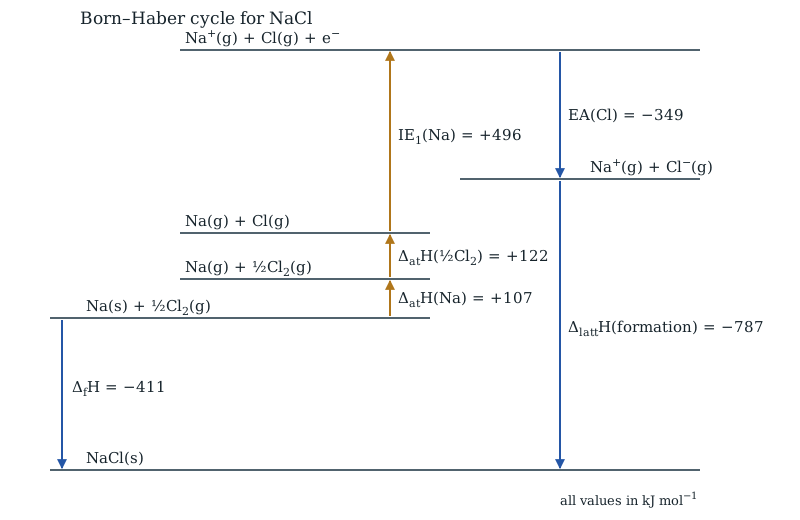
A Born–Haber cycle compares two routes to the same ionic solid. Route 1 is direct formation from the elements. Route 2 atomises both elements, ionises the metal, adds the electron affinity of the non-metal, then forms the lattice. By Hess's law the two routes are equal, so any missing term can be calculated.
Check it on NaCl: ΔH°f −411 = (+107 atomisation Na) + (+496 IE₁) + (+122 atomisation ½Cl₂) + (−349 EA) + lattice, which gives a lattice enthalpy of about −787 kJ mol⁻¹.
Comparing real lattices with the perfect ionic model is revealing. Agreement is good for NaCl, but large differences (e.g. AgI) mean covalent character — a small, highly charged cation polarises the anion.
Entropy and feasibility
ΔG = ΔH − TΔS · feasible when ΔG ≤ 0 · switch-over at T = ΔH/ΔSEntropy S rises with disorder — solid < liquid < gas — and with more moles of gas. An endothermic reaction can still be feasible if TΔS outweighs ΔH; that is exactly why ice melts above 0 °C.
Watch the units trap: ΔS is usually in J K⁻¹ mol⁻¹, so divide by 1000 before mixing it with ΔH in kJ.
3.1.8.1The NaCl Born–Haber cycle, fully worked
- The formation route equals atomise both elements + ionise + electron affinity + lattice formation.
- Substitute the numbers: −411 = 107 + 496 + 122 + (−349) + ΔH(latt).
- Rearranging gives ΔH(latt) = −411 − 376 = −787 kJ mol⁻¹.
3.1.8.1Dissolving: lattice vs hydration
ΔH(solution) = −ΔH(lattice formation) + Σ ΔH(hydration). For NaCl that is +787 + (−406 −378) = ≈ +3 kJ mol⁻¹ — slightly endothermic, so dissolving is driven by the entropy increase instead.
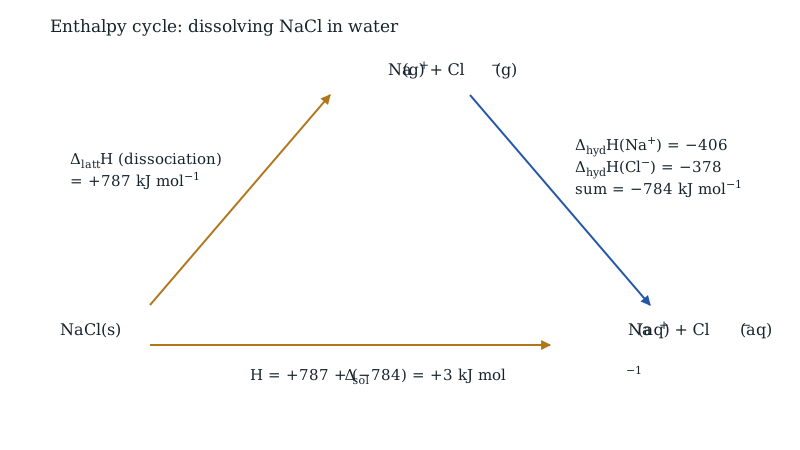
Hydration enthalpy is more exothermic for smaller, more highly charged ions, because the ion–dipole attraction to water is stronger.
3.1.8.2ΔG worked example
- Convert the entropy first: ΔS = 0.160 kJ K⁻¹ mol⁻¹.
- The reaction is feasible when ΔG ≤ 0, so T ≥ ΔH/ΔS = 178 ÷ 0.160 ≈ 1110 K — which is why limekilns run hot.
The full Thermodynamics chapter — every remaining section, the Mastery Vault, chapter quizzes and AI-marked exams — is in ChemLab.
Continue in the app