Energetics
Enthalpy changes, calorimetry, Hess's law, bond enthalpies
Hess's law
Hess's law says the enthalpy change of a reaction is independent of the route taken. That lets you find a ΔH you cannot measure directly by building a cycle from data you can.
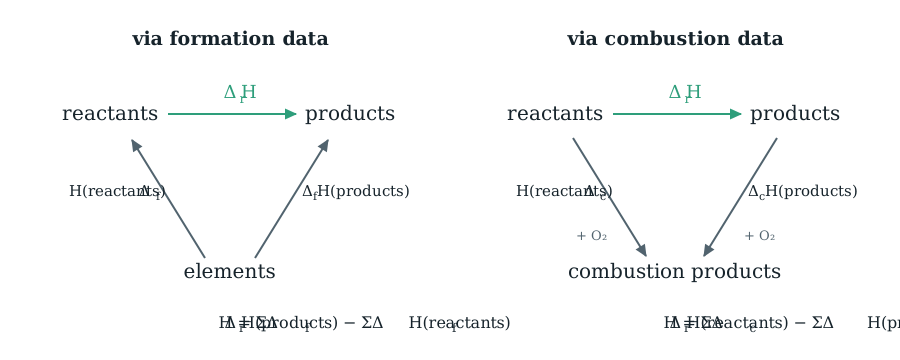
From formation data, ΔH = Σ ΔH°f(products) − Σ ΔH°f(reactants). From combustion data, ΔH = Σ ΔH°c(reactants) − Σ ΔH°c(products) — note the direction flips.
Bond enthalpies
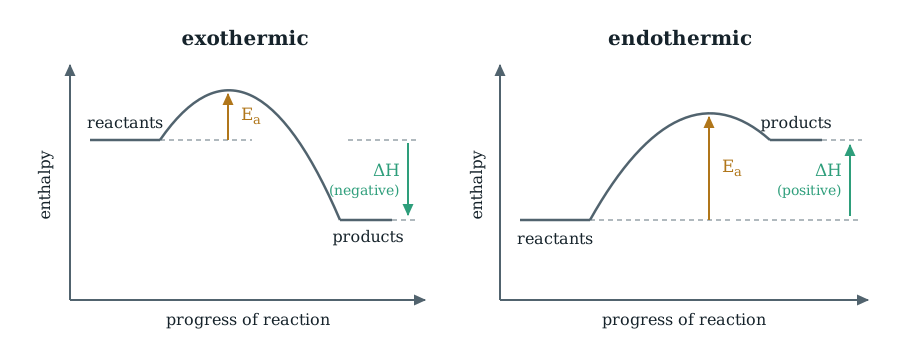
ΔH ≈ Σ(bonds broken) − Σ(bonds made): breaking bonds is endothermic (+), making them is exothermic (−). Because the values are means over many compounds, answers differ from Hess-law values — a favourite exam point.
See the energy profile simulation to connect Ea and ΔH visually.
3.1.4.4Hess cycles with combustion data
- Route via the combustion products: ΔH°f = Σ ΔH°c(elements) − ΔH°c(compound).
- Substituting gives [−394 + 2(−286)] − (−890).
- That works out to −966 + 890 = −76 kJ mol⁻¹.
3.1.4.2Calorimetry checklist
In q = m c ΔT, m is the mass of the solution (or water) being heated, c = 4.18 J g⁻¹ K⁻¹, and ΔT comes from a cooling-corrected graph. Divide q by moles of the limiting reagent, then convert J → kJ; the sign follows the temperature change (a rise means negative ΔH).
Evaluation points examiners pay for: heat loss to the surroundings; incomplete combustion (fuels); assuming the solution has water's density and specific heat capacity; and evaporation.
3.1.4.5Mean bond enthalpies (AQA-convention values, kJ mol⁻¹)
| Bond | kJ mol⁻¹ | Bond | kJ mol⁻¹ | Bond | kJ mol⁻¹ |
|---|---|---|---|---|---|
| C–H | 413 | C–C | 347 | C=C | 612 |
| O–H | 464 | O=O | 498 | C=O (in CO₂) | 805 |
| H–H | 436 | N≡N | 945 | C–Cl | 346 |
- Bonds broken: 4 C–H + 2 O=O = 4(413) + 2(498) = 2648 kJ.
- Bonds made: 2 C=O + 4 O–H = 2(805) + 4(464) = 3466 kJ.
- So ΔH ≈ 2648 − 3466 = −818 kJ mol⁻¹ (data-book −890: mean values are averages over many compounds).
Deep dive📚 The rest of the chapter, in full
Definitions that must be word-perfect
Standard enthalpy of combustion, ΔcH°: the enthalpy change when one mole of a substance burns completely in oxygen, all species in standard states at 100 kPa and a stated temperature.
Standard enthalpy of formation, ΔfH°: the enthalpy change when one mole of a compound forms from its elements in their standard states at 100 kPa. ΔfH° of any element in its standard state is zero.
Standard enthalpy of neutralisation: the enthalpy change when one mole of water is formed in the reaction of an acid with a base under standard conditions (≈ −57 kJ mol⁻¹ for strong acid + strong base).
Hess's law: the two cycle recipes
Using formation data: ΔrH = ΣΔfH(products) − ΣΔfH(reactants) — arrows go UP from elements to both sides. Using combustion data: ΔrH = ΣΔcH(reactants) − ΣΔcH(products) — arrows go DOWN to the combustion products. If you can only remember one thing: reverse an arrow, reverse its sign; multiply an equation, multiply its ΔH.
Bond enthalpy calculations — and their built-in error
ΔrH ≈ Σ(bonds broken) − Σ(bonds made). Breaking is endothermic (+), making is exothermic (−). Values are mean bond enthalpies averaged over many compounds and defined for the gaseous state — two reasons answers differ from Hess-law values: real bonds in this molecule are not average bonds, and any liquid species adds vaporisation terms the calculation ignores.
Calorimetry pitfalls (they examine these, not the formula)
q = mcΔT uses the mass of the liquid being heated, not the fuel or the solid added; c = 4.18 J g⁻¹ K⁻¹ is water's value. Convert J → kJ before dividing by moles, and attach the sign by logic: if the temperature rose, the reaction is exothermic, so ΔH is negative.
The main error sources are heat loss to the surroundings and apparatus, incomplete combustion, evaporation from the wick, and the assumption that the solution's specific heat capacity equals pure water's. Fixes: draught shields, lids, closer flames — or the graphical cooling correction from RP2.
Extended🎓 Beyond the standard course
ΔH vs ΔU: enthalpy is heat at constant pressure, while internal energy is heat at constant volume. They differ by the expansion work pΔV = Δn(gas)·RT — small but real when the number of gas moles changes.
Standard states matter: carbon's is graphite, not diamond — diamond sits 1.9 kJ mol⁻¹ above it, so ΔH°f(diamond) ≠ 0.
Hess's law is the first law of thermodynamics in disguise: if enthalpy depended on route you could run a cycle and create energy. And real calorimetry calibrates the whole apparatus (its "heat capacity" in J K⁻¹) with an electrical heater or standard reaction, sidestepping the water-only assumption schools make.
Mastery vault🏛 Every remaining spec point, banked
Bond enthalpy data bank (learn the ballpark, quote from the paper)
| Bond | H–H | C–H | C–C | C=C | C≡C | O–H | O=O | C=O (in CO₂) | Cl–Cl | H–Cl | N≡N |
|---|---|---|---|---|---|---|---|---|---|---|---|
| kJ mol⁻¹ | 436 | 412 | 347 | 612 | 837 | 463 | 496 | 805 | 243 | 432 | 945 |
Patterns worth knowing: N≡N's enormous value explains nitrogen's inertness (and why the Haber process needs a catalyst and heat); C=C is less than twice C–C, which is why addition across the π-bond is exothermic and alkenes are reactive.
Flame calorimetry, end to end
Enthalpy of neutralisation experiments
Mix measured volumes of acid and alkali in a polystyrene cup, take the temperature rise, and use the TOTAL solution mass in q = mcΔT. Strong–strong pairs all give ≈ −57 kJ per mole of water — the reaction is just H⁺ + OH⁻ → H₂O. Weak acids give slightly less exothermic values because energy is spent dissociating the acid first — a favourite explain-the-difference question.
Hess with mixed data — the sign discipline
Write the target equation, then build the cycle. Any step you traverse AGAINST its arrow flips sign; any step scaled ×n scales its ΔH ×n.
With formation data, ΔrH = ΣΔfH(products) − ΣΔfH(reactants); with combustion data, ΔrH = ΣΔcH(reactants) − ΣΔcH(products). If you mix data types, draw the full cycle rather than trusting either formula.
Watch for elements (ΔfH = 0) and for equations already containing fractional coefficients — keep the fractions, because halving "to make it neat" halves your answer.
Where energetics meets life
Self-heating cans run on CaO + H₂O → Ca(OH)₂, which is exothermic, while sports cold packs dissolve NH₄NO₃, which is endothermic (entropy-driven — a Year-2 callback). Reusable hand-warmers crystallise supersaturated sodium ethanoate, releasing enthalpy as the solid orders itself.
Fuel comparisons weigh energy per gram against energy per mole and CO₂ per kJ. Hydrogen wins per gram (143 kJ g⁻¹) but loses on storage density; methane beats coal on CO₂ per kJ.
Energetics II: Combustion Calorimetry and Formation Cycles
This section pushes past the basics: a full spirit-burner combustion, an enthalpy-of-solution calorimetry, formation via a Hess cycle, and the exact vs mean bond-enthalpy distinction.
Four enthalpies, one glance:
| ΔHc⦵ combustion — 1 mol substance burned completely in excess O2. Always negative. |
| ΔHf⦵ formation — 1 mol compound from elements in standard states. Can be + or −; element ΔHf = 0. |
| ΔHr⦵ reaction — per mole as written in the equation. |
| ΔHneut⦵ neutralisation — 1 mol H2O formed from H+(aq) + OH−(aq). |
Worked: ΔHc of ethanol from a spirit burner. Burning ethanol (M = 46.0) heats 150 g water from 19.0 °C to 41.5 °C. Burner mass falls from 218.60 g to 217.42 g.
Step 1 — heat gained by water. q = mcΔT = 150 × 4.18 × (41.5 − 19.0) = 150 × 4.18 × 22.5 = 14 108 J = 14.108 kJ.
Step 2 — mass of fuel burnt. 218.60 − 217.42 = 1.18 g.
Step 3 — moles of ethanol. n = 1.18 ÷ 46.0 = 0.02565 mol.
Step 4 — enthalpy per mole. ΔHc = −(14.108 ÷ 0.02565) = −550 kJ mol⁻¹ (3 s.f.). The sign is negative because the water gained the energy the fuel released.
The data-book value is −1367 kJ mol⁻¹ — the experiment is far less exothermic. Standard mark points: heat loss to the air, beaker and unburnt vapour; incomplete combustion (soot on the base = carbon, not CO2, so less energy released); evaporation of ethanol without burning; and non-standard conditions (water is not at 298 K, product water is liquid but conditions differ). Never write "the equipment was faulty".
Worked: enthalpy of solution. Dissolving 4.00 g NH4NO3 (M = 80.0) in 50.0 g water drops the temperature from 21.0 °C to 14.6 °C. q = 50.0 × 4.18 × (21.0 − 14.6) = 1338 J. n = 4.00 ÷ 80.0 = 0.0500 mol. ΔHsol = +1338 ÷ 0.0500 = +26.8 kJ mol⁻¹ (endothermic — temperature fell, so ΔH is positive).
Worked: ΔHf of methane by Hess cycle. Route via combustion: C(s) + 2H2(g) → CH4(g). Using ΔHc: C = −394, H2 = −286, CH4 = −890 kJ mol⁻¹.
ΔHf = Σ ΔHc(reactants) − Σ ΔHc(products)
= [(−394) + 2(−286)] − [(−890)] = (−966) − (−890) = −76 kJ mol⁻¹. Watch the double sign flip on the product term.
Exact vs mean bond enthalpy. Breaking the four C–H bonds in CH4 one at a time gives four different bond dissociation enthalpies (the molecule changes each time). The mean bond enthalpy is their average, +413 kJ mol⁻¹, quoted for a bond averaged across many molecules. That is why bond-enthalpy answers only ever approximate ΔH — the values are not exact for one specific compound.
This chapter has interactive quizzes, exam-style questions with AI marking, and live simulations in the ChemLab app.
Open ChemLab — free to start