Acids, bases & buffers
pH, Ka, titration curves, indicators
For a weak acid, [H⁺] ≈ √(Ka × c). Ethanoic acid has Ka = 1.74 × 10⁻⁵ (pKa 4.76), so a 0.10 mol dm⁻³ solution gives pH ≈ 2.9. At half-equivalence in a weak acid titration, pH = pKa — that is how Ka is measured in required practical 9.
Buffers
A buffer resists pH change when small amounts of acid or base are added. You make one from a weak acid plus its salt, or by part-neutralising an excess of the weak acid.
Added H⁺ is removed by A⁻ → HA, while added OH⁻ is removed by HA → A⁻ + H₂O. Because the reservoirs of HA and A⁻ are large, their ratio — and hence the pH — stays nearly constant.
Choosing an indicator
The indicator's range must fall inside the vertical section of the curve. For strong–strong, either common indicator works. For weak acid–strong base pick phenolphthalein (8.3–10.0); for strong acid–weak base pick methyl orange (3.1–4.4). Weak–weak curves have no sharp section, so no indicator works — use a pH meter.
The titration simulation lets you test all of this live.
3.1.12.3The four pH calculations you must do on demand
| System | Method |
|---|---|
| Strong acid | pH = −log[HA] (fully dissociated) |
| Strong base | [OH⁻] → [H⁺] = Kw ÷ [OH⁻] → pH |
| Weak acid | [H⁺] = √(Ka × c) → pH |
| Buffer | [H⁺] = Ka × [HA]/[A⁻] → pH |
- First find [H⁺] = Ka × [HA]/[A⁻] = 1.74 × 10⁻⁵ × (0.10 ÷ 0.050) = 3.48 × 10⁻⁵.
- Then pH = −log(3.48 × 10⁻⁵) = 4.46.
- Convert via Kw: [H⁺] = Kw ÷ [OH⁻] = 1.0 × 10⁻¹⁴ ÷ 0.050 = 2.0 × 10⁻¹³.
- That gives pH = 12.70.
3.1.12.5Reading titration curves
There are four shapes to recognise: strong–strong (vertical ~3–11), weak acid–strong base (starts ~3, vertical ~7–11), strong acid–weak base (vertical ~3–7, ends ~11) and weak–weak (no vertical section — no indicator works).
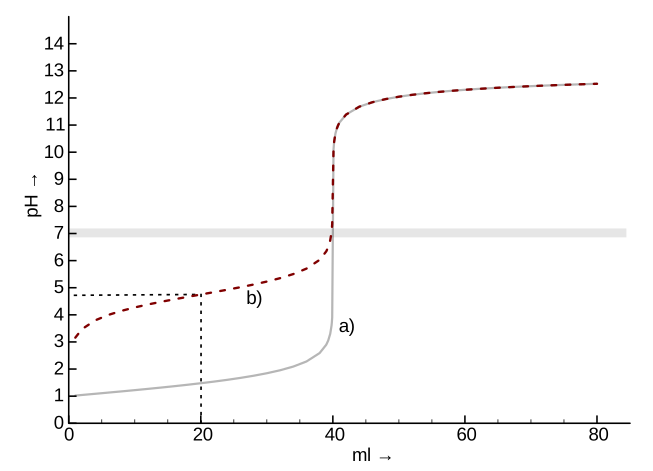
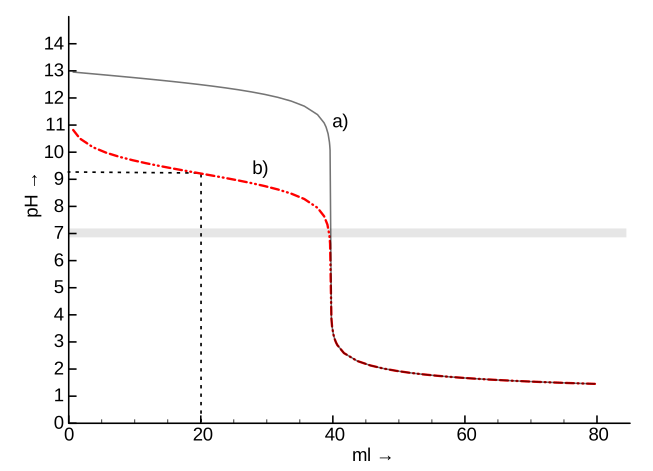
At half-equivalence, pH = pKa, and this is where buffering is strongest. The equivalence point for weak acid–strong base sits above 7 because the salt's anion is a base. Diprotic acids show two vertical sections — two equivalence points, at V and 2V.
Deep dive📚 The rest of the chapter, in full
The full Acids, bases & buffers chapter — every remaining section, the Mastery Vault, chapter quizzes and AI-marked exams — is in ChemLab.
Continue in the app