Bonding & structure
Ionic, covalent, metallic · shapes of molecules · intermolecular forces
Shapes of molecules (electron-pair repulsion)
Pairs of electrons around a central atom repel to maximum separation, and lone pairs repel more than bonding pairs, closing bond angles by ≈2.5° each. Count the pairs and the shape follows.
Two pairs give linear, 180° (CO₂); three give trigonal planar, 120° (BF₃); four give tetrahedral, 109.5° (CH₄). With three bonds and one lone pair the shape is pyramidal, 107° (NH₃); two bonds and two lone pairs give bent, 104.5° (H₂O); six pairs give octahedral, 90° (SF₆).
Intermolecular forces, weakest → strongest
Induced dipole–dipole (London/dispersion) forces act in everything, and they grow with electron count and surface contact — that is why boiling points rise down group 7 and fall with branching. Permanent dipole–dipole forces act between polar molecules such as HCl, on top of the London forces already present.
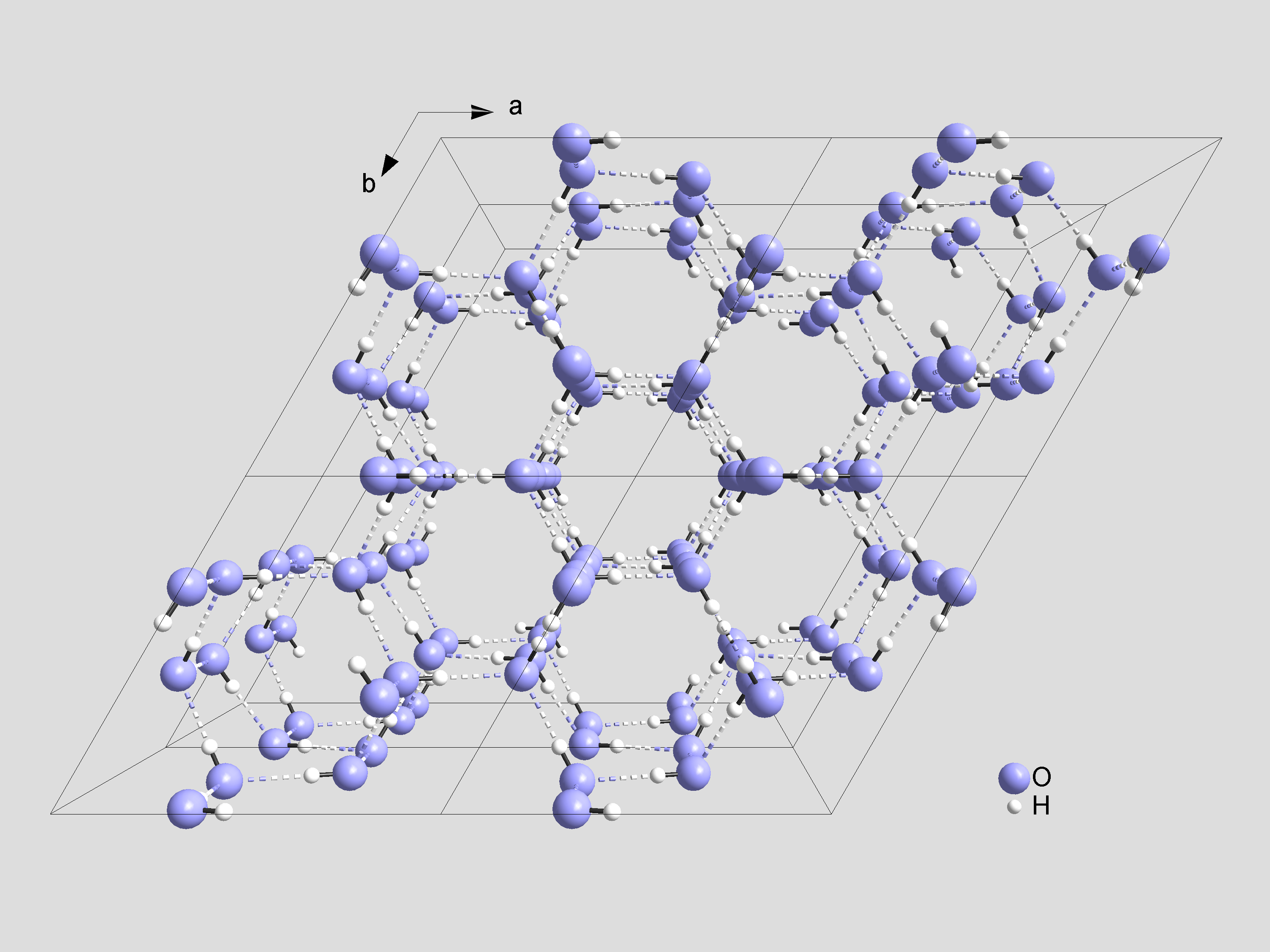
Hydrogen bonding is the strongest: H bonded to N, O or F is attracted to a lone pair on N/O/F of another molecule. It explains water's high boiling point and why ice is less dense than water (an open lattice held by H-bonds).
Structure determines properties
Giant ionic structures have high melting points and conduct only when molten or aqueous, once the ions are free to move. Giant covalent structures (diamond, graphite, SiO₂) have very high melting points, and graphite conducts via delocalised electrons between its layers. Simple molecular substances melt low — only the weak intermolecular forces break, never the covalent bonds.
3.1.3.5Shapes summary — learn this table cold
| Bond pairs | Lone pairs | Shape | Angle | Example |
|---|---|---|---|---|
| 2 | 0 | Linear | 180° | CO₂, BeCl₂ |
| 3 | 0 | Trigonal planar | 120° | BF₃, AlCl₃ |
| 4 | 0 | Tetrahedral | 109.5° | CH₄, NH₄⁺ |
| 3 | 1 | Trigonal pyramidal | 107° | NH₃, PCl₃ |
| 2 | 2 | Bent | 104.5° | H₂O, H₂S |
| 5 | 0 | Trigonal bipyramidal | 120° & 90° | PCl₅ |
| 6 | 0 | Octahedral | 90° | SF₆ |
3.1.3.2Co-ordinate (dative covalent) bonding
In a co-ordinate bond, both shared electrons come from one atom. That is how NH₄⁺ forms (N donates to H⁺), along with H₃O⁺, Al₂Cl₆ and every metal–ligand bond in complex ions. Once formed it is identical to any other covalent bond — all four N–H bonds in NH₄⁺ are equivalent.
3.1.3.1The four crystal types
| Type | Particles / forces | Example | Properties |
|---|---|---|---|
| Ionic | ions, electrostatic attraction | NaCl | high mp; conducts molten/aq only; brittle |
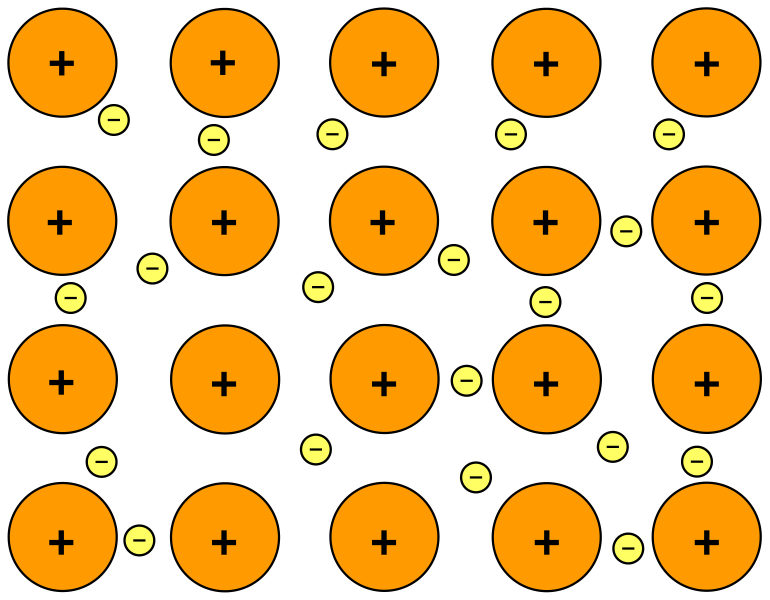
| Metallic | cations + delocalised electrons | Mg | conducts as solid; malleable; mp rises with charge |
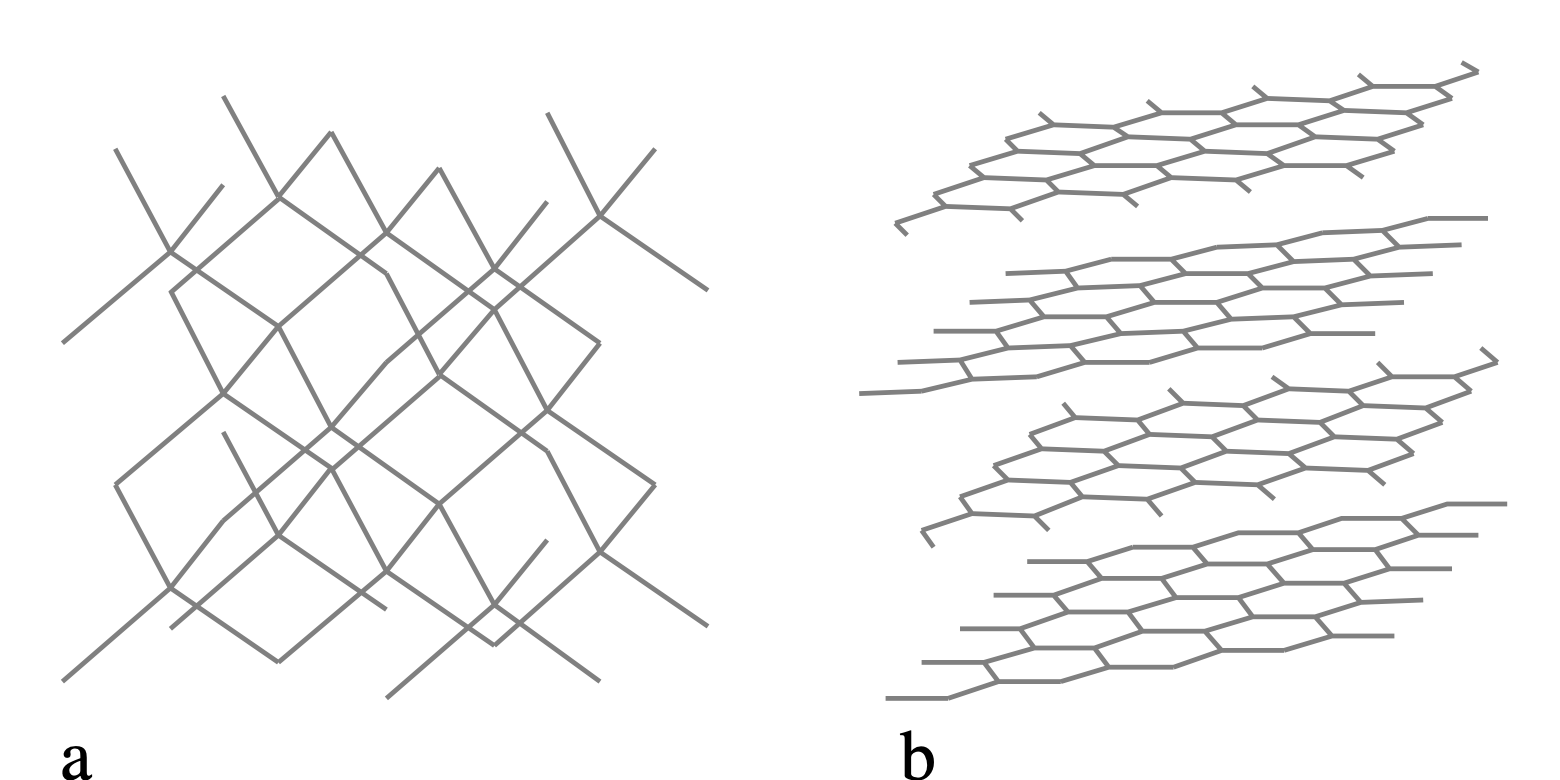
| Macromolecular | atoms, covalent network | diamond, graphite, SiO₂ | very high mp; graphite conducts (delocalised layer electrons) |
| Molecular | molecules, weak IMFs | I₂, ice | low mp; never conducts |
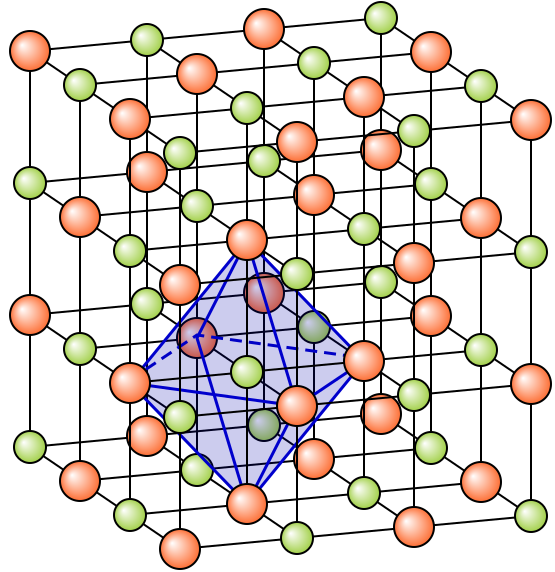
- N has 5 outer electrons; 4 bonds (one dative) use all of them, giving 4 bonding pairs and 0 lone pairs.
- Maximum separation of 4 pairs makes the ion tetrahedral, 109.5°.
Deep dive📚 The rest of the chapter, in full
The complete shapes table
| Bond pairs | Lone pairs | Shape | Angle | Example |
|---|---|---|---|---|
| 2 | 0 | Linear | 180° | CO₂, BeCl₂ |
| 3 | 0 | Trigonal planar | 120° | BF₃, NO₃⁻, CO₃²⁻ |
| 4 | 0 | Tetrahedral | 109.5° | CH₄, NH₄⁺, SO₄²⁻ |
| 3 | 1 | Trigonal pyramidal | 107° | NH₃, PCl₃, H₃O⁺ |
| 2 | 2 | Bent | 104.5° | H₂O, H₂S |
| 5 | 0 | Trigonal bipyramidal | 120° & 90° | PCl₅ |
| 6 | 0 | Octahedral | 90° | SF₆ |
| 4 | 2 | Square planar | 90° | XeF₄ |
Each lone pair squeezes bonding angles by about 2.5° — lone-pair/lone-pair repulsion > lone-pair/bond > bond/bond. For unfamiliar ions, count electrons: for NH₄⁺, N has 5 outer electrons + 4 from H − 1 for the positive charge = 8 = 4 bonding pairs → tetrahedral.
Polarity: bond vs molecule
A bond is polar when the two atoms differ in electronegativity (F 4.0 > O 3.4 > N ≈ Cl 3.0). A molecule is only polar if the bond dipoles do not cancel. CO₂ (linear) and CCl₄ (tetrahedral) contain polar bonds but are non-polar molecules — the dipoles cancel by symmetry. H₂O and CHCl₃ are polar because theirs do not. This distinction is worth a mark almost every year.
Ranking boiling points — the examiner's favourite
Hydrogen bonding needs H bonded directly to N, O or F, plus a lone pair on the acceptor. It explains why H₂O boils at 100 °C while H₂S boils at −60 °C, why ice is less dense than water (an open hydrogen-bonded lattice), and why NH₃, H₂O and HF break their groups' trends.
Permanent dipole–dipole forces act between polar molecules such as CH₃Cl. Induced dipole (London) forces act between everything and grow with electron count and contact area: boiling points climb along the alkanes, and branched isomers boil lower than straight chains (2,2-dimethylpropane −10 °C vs pentane 36 °C) because branching reduces surface contact.
The four crystal types
| Type | Particles & forces | Melts | Conducts? | Examples |
|---|---|---|---|---|
| Ionic | Ions, electrostatic attraction | High | Only molten or aqueous | NaCl, MgO |
| Metallic | Cations in delocalised electrons | Variable–high | Yes (electrons) | Mg, Al |
| Simple molecular | Molecules, weak IMFs broken on melting | Low | No | I₂, ice, CO₂ |
| Macromolecular | Atoms, covalent bonds broken on melting | Very high | Graphite only | Diamond, SiO₂, graphite |
Graphite conducts because each carbon bonds to only three others, leaving one delocalised electron per atom between layers; the layers slide (lubricant). Diamond's four bonds per carbon make it the hardness benchmark. Graphene is a single graphite layer — the strongest known material and an excellent conductor.
Extended🎓 Beyond the standard course
Dipoles add as vectors. CO₂'s two large bond dipoles cancel; CHCl₃'s don't. cis/trans isomers can differ in polarity — trans-1,2-dichloroethene is non-polar, the cis isomer polar.
Bond order sets length and strength: C–C ≈ 154 pm, C=C ≈ 134 pm, C≡C ≈ 120 pm. Benzene's six equal 140 pm bonds — between single and double — are the structural evidence for delocalisation.
Polarisability matters too: big, soft anions (I⁻) are easily distorted by small, highly-charged cations. That distortion is the origin of covalent character in "ionic" solids like AgI, and the deeper reason London forces grow with electron count.
Hydrogen bonds are ~20 kJ mol⁻¹ — an order of magnitude weaker than covalent bonds (~350) but decisive in bulk: water's boiling point sits ~200 °C above the group trend. Water out-boils HF because each H₂O averages more hydrogen bonds per molecule (two donors, two acceptors). Ice's density anomaly is a lattice constraint: the tetrahedral H-bond network enforces open hexagonal channels that collapse on melting.
Mastery vault🏛 Every remaining spec point, banked
Ionic bonding, quantitatively
Lattice attraction grows with charge and shrinks with ionic radius: MgO (2+/2−, small ions) melts at 2852 °C vs NaCl (1+/1−) at 801 °C — which is why MgO lines furnaces. Isoelectronic series N³⁻ > O²⁻ > F⁻ > Na⁺ > Mg²⁺ > Al³⁺ shrink steadily: same electrons, rising nuclear charge. Evidence for ions: molten and aqueous conductivity, and electrolysis migrating coloured ions (Cu²⁺ blue to the cathode, CrO₄²⁻ yellow to the anode).
Electronegativity values worth memorising
| Element | H | C | N | O | F | Na | Mg | Al | Si | P | S | Cl |
|---|---|---|---|---|---|---|---|---|---|---|---|---|
| Pauling EN | 2.2 | 2.6 | 3.0 | 3.4 | 4.0 | 0.9 | 1.3 | 1.6 | 1.9 | 2.2 | 2.6 | 3.2 |
ΔEN ≳ 1.8 → predominantly ionic; 0.4–1.8 → polar covalent; < 0.4 → essentially non-polar. C–H (Δ0.4) counts as non-polar — the reason alkanes have only London forces. The ionic/covalent boundary is a continuum: large ΔEN with a polarising cation (AlCl₃) lands in between, subliming at 180 °C like a covalent solid.
Force magnitudes — why rankings work
| Interaction | Typical strength / kJ mol⁻¹ |
|---|---|
| Covalent bond | 150–500 |
| Hydrogen bond | 20–40 |
| Permanent dipole–dipole | 3–25 |
| London (induced dipole) | 1–10 per contact, additive |
Melting a simple molecular solid breaks only the intermolecular forces — the covalent bonds survive (I₂ vapour is still I₂). Only macromolecular melting breaks covalent bonds. This single distinction settles most "explain the melting point" questions.
Solubility logic
Ionic solids dissolve in water when hydration energy (ion–dipole attraction) repays lattice energy: the δ− oxygens surround cations while the δ+ hydrogens surround anions. Alcohols mix with water via hydrogen bonding, but solubility falls as the non-polar chain grows — hexan-1-ol barely dissolves.
Non-polar solutes dissolve in non-polar solvents (iodine in cyclohexane, purple). "Like dissolves like" is the pattern, but argue it through which forces form versus which break.
Harder shape calls
ClF₃ has 7 + 3 = 10 electrons around Cl, giving 3 bond pairs and 2 lone pairs: T-shaped, ~87.5°. Compare SF₆ with SF₄ — 6 pairs give octahedral 90°, while 5 pairs with one lone pair give seesaw.
For ions, subtract electrons for + and add for −. NO₃⁻ (N has 5 + 3 shared considerations) comes out trigonal planar, 120°, with delocalised π — quote 120° and equal bond lengths. And keep the lone-pair rule of thumb: each lone pair takes −2.5° off the parent angle (109.5 → 107 → 104.5).
Deeper bonding: water's anomalies, hydrogen bonding & giant structures
Why the bond angle order is H2O (104.5°) < NH3 (107°) < CH4 (109.5°). All three have four electron pairs around the central atom, so the base geometry is tetrahedral. Methane has no lone pairs, giving the ideal 109.5°. Ammonia has one lone pair; oxygen in water has two. Lone pairs sit closer to the central atom and repel more strongly than bonding pairs, so the repulsion order is lone–lone > lone–bond > bond–bond. Each lone pair squeezes the bonding pairs together, reducing the angle by roughly 2.5° per lone pair.
Anomalous properties of water and ice. Water molecules form hydrogen bonds because H is bonded to highly electronegative O, which carries two lone pairs. This gives water an unusually high melting and boiling point for its small Mr (18): far more energy is needed to overcome the H-bonds than the weak London forces in comparably sized molecules. Water also has high surface tension because surface molecules are pulled inward by H-bonding.
Why ice floats. In ice each water molecule forms four hydrogen bonds in a rigid, open tetrahedral lattice. This holds the molecules further apart than in the liquid, so ice is less dense than water and floats. On melting, the lattice partially collapses and molecules pack closer, so water reaches maximum density at 4°C. This is why lakes freeze from the top down.
Hydrogen bonding compared. HF, NH3, water and alcohols (R–O–H) hydrogen bond because H is attached directly to N, O or F. Ethers (R–O–R) cannot: they have no O–H bond, so despite polar C–O bonds they show only permanent dipole and London forces, giving lower boiling points than alcohols of similar Mr.
Explain why butan-1-ol (bp 118°C) boils higher than ethoxyethane (bp 35°C), both C4H10O.
Both molecules have equal Mr and similar electron counts, so their London forces are comparable. Butan-1-ol contains an O–H group, so its molecules form hydrogen bonds with one another. Ethoxyethane has no O–H bond, so it can only form permanent dipole–dipole and London interactions. Hydrogen bonds are stronger than these, so more energy is required to separate butan-1-ol molecules, giving the higher boiling point.
Giant covalent carbon structures. Diamond: each C bonded to 4 others tetrahedrally, very hard, high melting point, does not conduct (no delocalised electrons). Graphite: each C bonded to 3 others in layers with delocalised electrons between layers, so it conducts and is a soft lubricant (weak London forces between sliding layers). Graphene is a single graphite layer: strong and conducting. Fullerenes (e.g. C60) are molecular, not giant, so they melt/dissolve more easily.
Metallic bonding trends. Strength is the attraction between positive ions and delocalised electrons. Higher ionic charge and smaller ionic radius mean stronger bonding, so Mg (2+, smaller) has a higher melting point and better conductivity than Na (1+), because it releases more delocalised electrons per atom.
This chapter has interactive quizzes, exam-style questions with AI marking, and live simulations in the ChemLab app.
Open ChemLab — free to start