Organic chemistry
Mechanisms, functional groups, test-tube analysis
The mechanisms to know cold
Four mechanisms carry most of the organic marks. Free-radical substitution is alkanes reacting with Cl₂ under UV, and it always runs initiation → propagation → termination. Electrophilic addition is alkenes with HBr or Br₂: Markovnikov's rule says H adds to the carbon with more H, because the more stable carbocation forms the major product.
Haloalkanes do nucleophilic substitution with OH⁻, CN⁻ or NH₃, and elimination with ethanolic KOH to give an alkene. Carbonyls undergo nucleophilic addition with HCN or NaBH₄, and benzene does electrophilic substitution (year 2).
Identifying functional groups (RP6 & RP10)
An alkene turns bromine water from orange to colourless. An aldehyde gives a silver mirror with Tollens' reagent and a brick-red precipitate with Fehling's; ketones give no change with either. Any carbonyl (C=O) gives an orange precipitate with 2,4-DNPH, and the precipitate's melting point identifies the compound.
A primary or secondary alcohol (or an aldehyde) turns acidified potassium dichromate from orange to green; a tertiary alcohol leaves it orange. A carboxylic acid fizzes with sodium carbonate — the CO₂ released turns limewater milky.
Distinguish an aldehyde from a ketone: both give orange ppt with 2,4-DNPH, but only the aldehyde gives a silver mirror with Tollens'.
3.3.1Naming and isomerism rules
To name a molecule, take the longest chain as the stem, number from the end giving the lowest locants, and list substituents alphabetically (di/tri are ignored when ordering). Structural isomers come in three types: chain, position and functional group.
Stereoisomers split into E/Z and optical (year 2). E/Z isomerism needs restricted rotation about the C=C and two different groups on each carbon — assign using CIP priority, where the higher atomic number wins. For optical isomerism, a carbon with four different groups is chiral: the two mirror-image enantiomers rotate plane-polarised light in opposite directions, and a 50:50 racemic mixture shows no rotation.
3.3.4The mechanisms, step by step
Free-radical substitution (CH₄ + Cl₂, UV) runs in three stages: initiation Cl₂ → 2Cl• (homolysis); propagation Cl• + CH₄ → HCl + •CH₃ then •CH₃ + Cl₂ → CH₃Cl + Cl•; termination, where any two radicals combine.
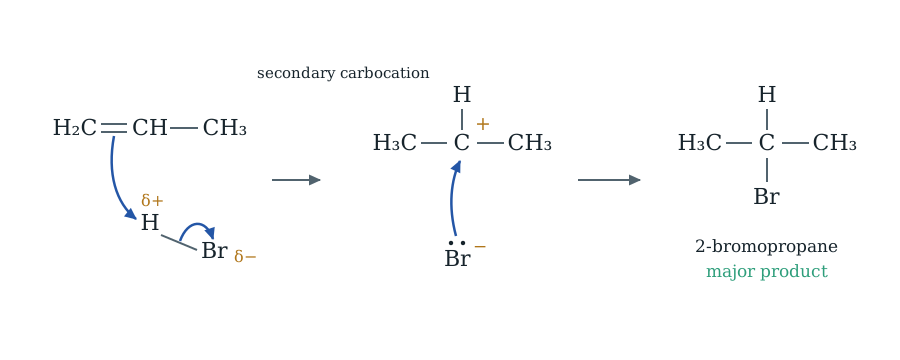
In electrophilic addition (propene + HBr), the π-electrons attack Hδ+. The H adds to the CH₂ end, giving the secondary carbocation; Br⁻ then attacks it to form 2-bromopropane, the major product.
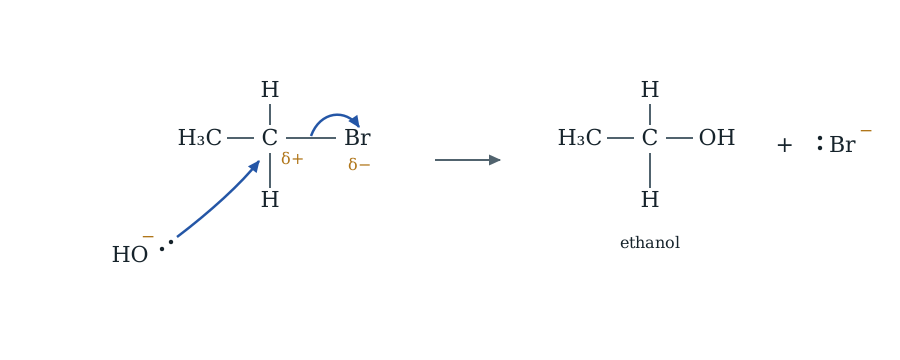
In nucleophilic substitution (haloalkane + OH⁻/CN⁻/NH₃), the nucleophile's lone pair attacks Cδ+ and the C–X bond breaks heterolytically. C–I reacts fastest because it is the weakest bond — bond enthalpy beats polarity. In elimination (haloalkane + ethanolic KOH, hot), OH⁻ acts as a base instead, removing an H from the carbon adjacent to C–X to give an alkene, water and a halide ion.
3.3.3Reaction condition pairs that decide the product
| Reagents | Conditions A → product | Conditions B → product |
|---|---|---|
| Haloalkane + KOH | aqueous, warm → alcohol (substitution) | ethanolic, hot → alkene (elimination) |
| 1° alcohol + K₂Cr₂O₇/H⁺ | distil as it forms → aldehyde | reflux, excess oxidant → carboxylic acid |
| Ethene → ethanol | steam + H₃PO₄ (industrial) | — (fermentation is the sugar route) |
The full Organic chemistry chapter — every remaining section, the Mastery Vault, chapter quizzes and AI-marked exams — is in ChemLab.
Continue in the app