Atomic structure
Subshells, ionisation energies, mass spectrometry
Trends across period 3
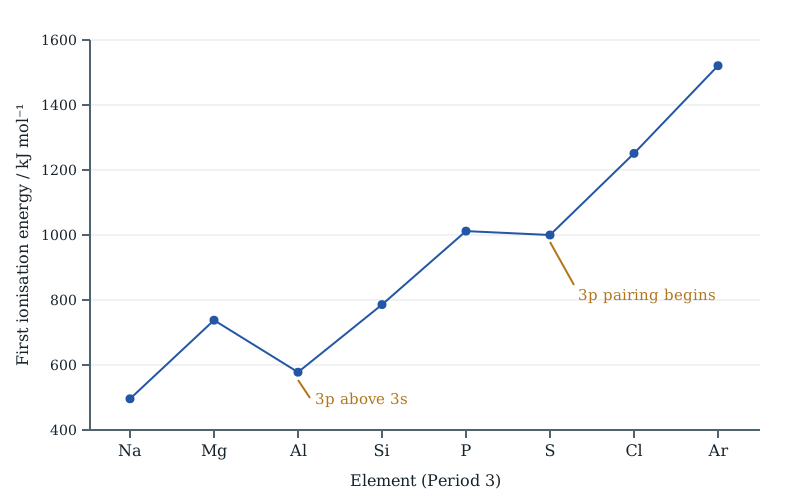
First ionisation energy generally increases across the period: nuclear charge rises while the outer electrons stay in the same shell, so the attraction to the nucleus gets stronger. Two dips break the trend, and both are evidence for subshells.
The first dip is Mg → Al (738 → 578 kJ mol⁻¹). Aluminium's outer electron sits in a 3p subshell, higher in energy than magnesium's 3s, so it takes less energy to remove. The second dip is P → S (1012 → 1000 kJ mol⁻¹): sulfur is where the 3p electrons first pair up, and repulsion between the paired electrons makes one easier to remove. The same logic explains Be → B and N → O in period 2 (899 → 801 and 1402 → 1314 kJ mol⁻¹).
Electron configuration rules
Orbitals fill in order of increasing energy: 1s 2s 2p 3s 3p, with 4s before 3d. Two exceptions are worth memorising — Cr is [Ar] 3d⁵ 4s¹ and Cu is [Ar] 3d¹⁰ 4s¹ — because half-filled and full d-subshells are extra stable. When transition metals ionise, the 4s electrons are lost first.
Time-of-flight mass spectrometry
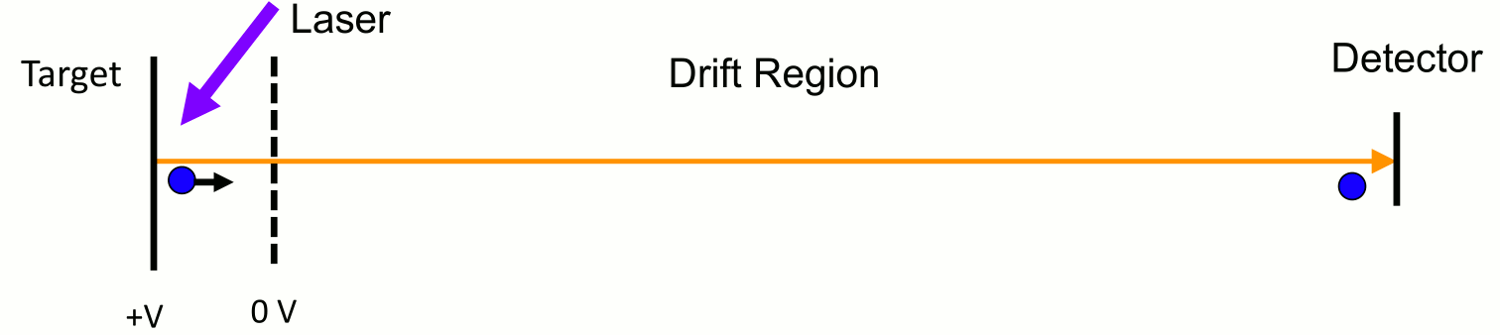
A time-of-flight instrument works in four stages. Ionisation (electron impact or electrospray) creates positive ions, then acceleration gives all ions the same kinetic energy. In the flight tube lighter ions travel faster, and at the detector the ions gain electrons, producing a current proportional to abundance.
Relative atomic mass comes straight from the spectrum: Ar = Σ(isotope mass × % abundance) ÷ 100
3.1.1.1Fundamental particles
| Particle | Relative mass | Relative charge | Where |
|---|---|---|---|
| Proton | 1 | +1 | nucleus |
| Neutron | 1 | 0 | nucleus |
| Electron | 1/1836 | −1 | shells / orbitals |
Mass number A counts protons plus neutrons; atomic number Z counts protons alone. Isotopes share the same Z but differ in A, so they have identical chemistry (same electron configuration) but different physical properties. When atoms form ions, only the electrons change — never the protons. Ti²⁺, for example, has 22 protons and 20 electrons.
3.1.1.3Successive ionisation energies — the evidence for shells
Removing each successive electron costs more, because the same number of protons is pulling on fewer electrons. A large jump between the nth and (n+1)th ionisation energies means the (n+1)th electron comes from a new shell, closer to the nucleus — so the element is in group n.
- Look at the jumps: ×3.1, ×1.5, then ×4.2 — the huge jump comes after the 3rd electron.
- Three easily-removed outer electrons put the element in group 3. (It is aluminium.)
- Apply the formula: Ar = (35 × 75 + 37 × 25) ÷ 100 = 35.5
Deep dive📚 The rest of the chapter, in full
Time-of-flight mass spectrometry, quantitatively
All four stages carry marks. Ionisation: either electron impact (a high-energy electron knocks one electron out: X(g) → X⁺(g) + e⁻ — used for low-mass samples, causes fragmentation) or electrospray (the sample gains a proton from the solvent: X(g) + H⁺ → XH⁺(g) — used for large biological molecules; remember the detected mass is M+1). Acceleration: an electric field gives every ion the same kinetic energy, so lighter ions end up faster. Flight: ions drift through a field-free tube; since KE = ½mv², the speed is v = √(2KE/m) and the flight time over distance d is t = d√(m/2KE) — time is proportional to √m. Detection: each ion gains an electron at the detector; the tiny current is proportional to abundance.
Reading mass spectra
Aᵣ from a spectrum: Aᵣ = Σ(isotope mass × % abundance) ÷ 100. For Cl (75% ³⁵Cl, 25% ³⁷Cl) that gives (35 × 75 + 37 × 25)/100 = 35.5.
Watch the diatomic traps: Cl₂ shows molecular-ion peaks at m/z 70, 72 and 74 (³⁵–³⁵, ³⁵–³⁷, ³⁷–³⁷) in a 9 : 6 : 1 ratio — a favourite multi-mark question. To work backwards when given Aᵣ and one abundance, set up x + y = 100 and solve the weighted mean for the unknown isotope.
Successive ionisation energies — the evidence for shells
Removing electrons one by one from the same atom gives a rising staircase with giant jumps between shells. For sodium: the 1st IE is small (lone 3s electron), then a huge jump to the 2nd (now breaking into the full n = 2 shell), then eight steadily rising values, then another leap into n = 1. Count the electrons removed before each jump to read off the group: an element whose big jump comes after the 2nd ionisation energy is in Group 2.
The two classic first-IE anomalies
Be → B (and Mg → Al): boron's outer electron is in 2p, higher in energy than beryllium's 2s and slightly shielded by it — so it needs less energy to remove despite the greater nuclear charge.
N → O (and P → S): oxygen is the first element to pair electrons in a 2p orbital. The paired electrons repel, making one easier to remove than nitrogen's three unpaired, half-filled-subshell electrons.
Configurations of ions
Write the atom first, then remove from the highest n first — 4s before 3d for transition metals: Fe is [Ar]3d⁶4s², Fe²⁺ is [Ar]3d⁶, Fe³⁺ is [Ar]3d⁵ (extra stability of the half-filled d-subshell explains why Fe²⁺ oxidises easily). Negative ions add electrons to the next empty orbital: O²⁻ is 1s²2s²2p⁶, isoelectronic with Ne, F⁻, Na⁺ and Mg²⁺ — but their radii differ because the nuclear charge differs.
Extended🎓 Beyond the standard course
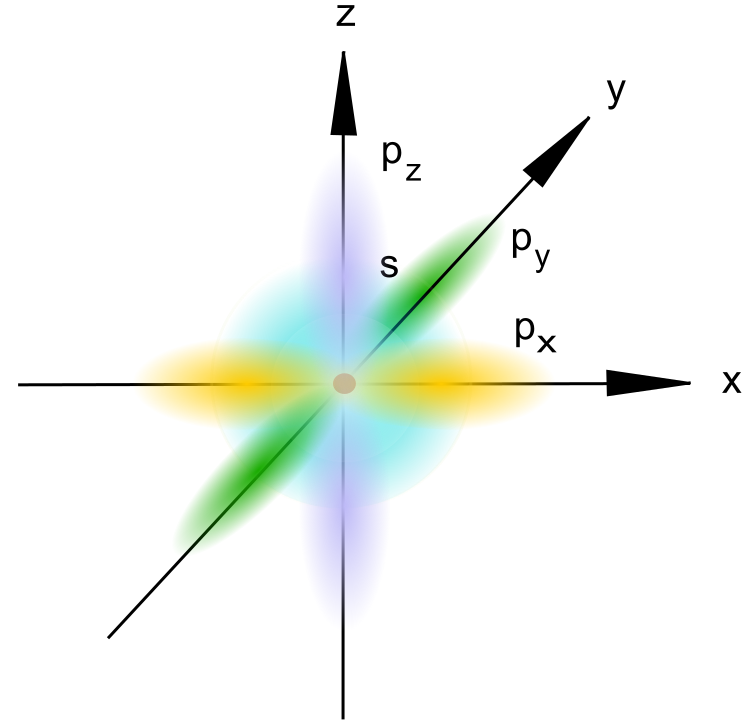
Orbital shapes: s orbitals are spherical, while the three p orbitals are dumbbells along x, y and z. An orbital is a region of 95% electron probability — not a track.
Why 4s fills before 3d: the 4s orbital penetrates closer to the nucleus than 3d, so in K and Ca it is lower in energy. Once 3d is occupied, the order flips — 3d electrons shield 4s poorly — which is exactly why 4s electrons are also lost first on ionisation.
Why Cr and Cu break Aufbau: half-filled (d⁵) and filled (d¹⁰) subshells maximise exchange energy. Electrons with parallel spins in separate d orbitals repel less and are quantum-mechanically stabilised.
Log plots of successive IEs compress the huge range and make shell breaks unmistakable — a favourite of harder data questions. And on EI vs ESI: electron-impact ionisation fragments molecules (rich fingerprint, weak M⁺), whereas electrospray is "soft" and preserves [M+H]⁺ — which is why it's used for proteins in TOF instruments.
Mastery vault🏛 Every remaining spec point, banked
The evolving model of the atom (spec 3.1.1.1)
Dalton: indivisible spheres. Thomson (1897): discovery of the electron → "plum pudding" of negative electrons in positive dough. Rutherford (1911): alpha-particle scattering — most passed straight through gold foil, a tiny fraction bounced back → mass and positive charge concentrated in a minute nucleus. Bohr: electrons in fixed energy levels, explaining line spectra. Modern quantum model: orbitals as probability regions. The examinable lesson: models are accepted, tested and replaced as evidence accumulates — name the evidence when you name the model.
Orbitals, subshells and the three filling rules
An orbital holds at most 2 electrons of opposite spin. s-orbitals are spherical and the three p-orbitals are dumbbells along x, y, z; the subshell capacities are s 2, p 6, d 10, f 14.
Three rules govern filling. Aufbau: fill lowest energy first (note 4s fills before 3d — and empties first in ions). Hund: within a subshell, occupy orbitals singly before pairing. Pauli: no two electrons in an atom share all four quantum labels — paired electrons must have opposite spins. Box-diagram questions test Hund directly: nitrogen's 2p is ↑ ↑ ↑, never ↑↓ ↑ –.
First ionisation energies across Period 3 — the data
| Element | Na | Mg | Al | Si | P | S | Cl | Ar |
|---|---|---|---|---|---|---|---|---|
| IE₁ / kJ mol⁻¹ | 496 | 738 | 578 | 786 | 1012 | 1000 | 1251 | 1521 |
General rise (increasing nuclear charge, same shell, similar shielding) with the two dips: Al (3p above 3s) and S (first 3p pairing). Sketch questions want the zigzag shape with those two elements below the trend line, labelled with the reasons.
Mass spectrometry: the corner cases
2+ ions appear at half the expected m/z: ⁵⁶Fe²⁺ registers at 28. If a peak sits at half-integer m/z (e.g. 43.5), suspect a 2+ ion of an odd-mass species (87).
Electrospray vs electron impact: electrospray adds a proton, so read Mᵣ = m/z − 1; electron impact reads Mᵣ directly from M⁺ but fragments the molecule (useful for structure, annoying for mass). Remember too that isotopes have identical chemical properties (same electron configuration) but different masses — hence different flight times, and slightly different physical properties (density, rate of diffusion).
Applications you can quote
¹⁴C dating (5730-year half-life) serves archaeology, ⁶⁰Co and ⁹⁹ᵐTc are used in radiotherapy and imaging, and ²³⁵U enrichment is monitored by mass spectrometry. Mass spectrometers also fly on space probes (identifying elements on Mars) and work in drug-testing labs and airport security — the same four-stage instrument every time.
➕ Deeper problems & the spectroscopic link
In time-of-flight (TOF), drift time t is proportional to √(m/z) because all ions gain the same kinetic energy KE = ½mv². Comparing two ions accelerated through the same field, t₁ / t₂ = √(m₁ / m₂) for singly-charged species. This lets you find one mass from another without knowing the tube length.
Drift-time ratio. A ⁵⁶Fe⁺ ion reaches the detector in 42.0 µs. Find the flight time of ⁵⁴Fe⁺ under identical conditions.
t(⁵⁴) = t(⁵⁶) × √(54/56) = 42.0 × √0.96429 = 42.0 × 0.98198 = 41.2 µs. The lighter ion arrives first, as expected.
Resolving overlapping envelopes. A high-resolution spectrometer separates species that a low-resolution instrument merges. N₂⁺ and CO⁺ both sit near m/z 28, but exact masses (N₂ = 28.0062, CO = 27.9949) differ in the third decimal, so a resolving power of a few thousand splits them. Likewise a doubly-charged ²⁴Mg²⁺ appears at m/z 12.0, exactly overlapping ¹²C⁺ unless exact masses distinguish them.
Quantum numbers at A-level depth. The principal quantum number n (1, 2, 3…) sets the shell and energy; the subsidiary number l labels sub-shell shape, with l = 0 → s, 1 → p, 2 → d, 3 → f. A shell of number n holds n sub-shells and a maximum of 2n² electrons: n = 3 gives 3s, 3p, 3d and up to 18 electrons. Energies overlap so 4s fills before 3d.
Exam-trap definitions. First ionisation energy: the energy to remove one mole of electrons from one mole of gaseous atoms forming one mole of gaseous 1+ ions — state gaseous and per mole or lose the mark. Relative atomic mass: the weighted mean mass of an atom relative to 1/12 the mass of one atom of ¹²C.
The spectroscopic link to ionisation energy. Excited electrons falling to lower shells emit photons of fixed frequency, giving the line emission spectrum. Lines converge to a limit at high frequency because energy levels crowd together as n increases (spacing → 0 near n = ∞). The Lyman series (transitions to n = 1) converges at the frequency where an electron is promoted from n = 1 to n = ∞ — i.e. removed. That convergence frequency therefore is the first ionisation energy of hydrogen.
IE from a convergence limit. The Lyman convergence frequency of hydrogen is 3.29 ×10¹⁵ Hz. Find the first ionisation energy in kJ mol⁻¹. (h = 6.63 ×10⁻³⁴ J s, N_A = 6.02 ×10²³ mol⁻¹.)
Energy per atom: E = hf = 6.63 ×10⁻³⁴ × 3.29 ×10¹⁵ = 2.18 ×10⁻¹⁸ J.
Per mole: 2.18 ×10⁻¹⁸ × 6.02 ×10²³ = 1.31 ×10⁶ J mol⁻¹ = 1310 kJ mol⁻¹, matching the tabulated value for hydrogen.
Convergence is easiest to see in absorption too: beyond the limit the spectrum becomes continuous because the electron is free and can take any energy.
Why relative masses are not whole numbers. Two reasons. First, R_a is a weighted average over isotopes — chlorine's 75% ³⁵Cl and 25% ³⁷Cl give 35.5. Second, even a single isotope's relative isotopic mass is not exactly integer: binding the nucleus converts a little mass to energy (mass defect), so ¹²C is the fixed reference at exactly 12 but ¹H is 1.0078, not 1.
| t ∝ √(m/z) | heavier or higher-charge ions separate |
|---|---|
| Convergence f | gives IE via E = hf × N_A |
This chapter has interactive quizzes, exam-style questions with AI marking, and live simulations in the ChemLab app.
Open ChemLab — free to start